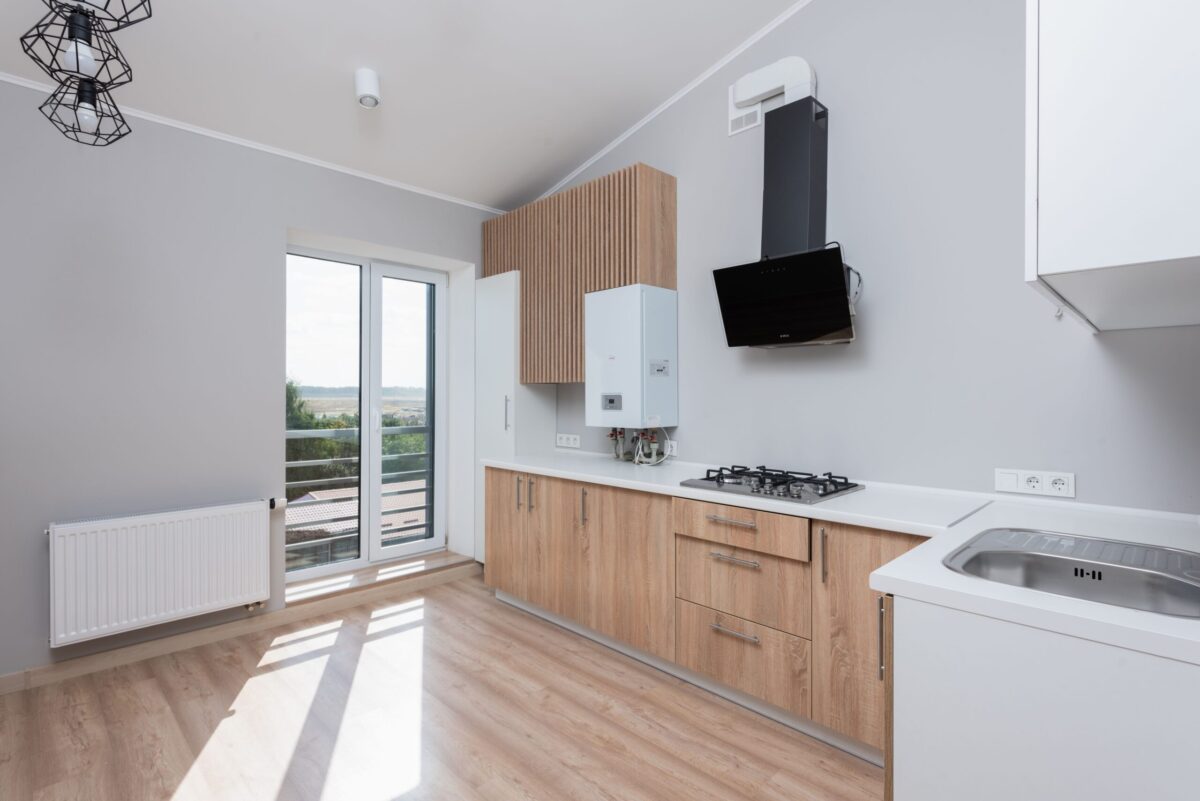
Aesthetic Minimalism is a layer on top of Minimalism. Minimalism, in general, is the idea of owning less, doing less, and keeping less. It is a subtractive approach. Aesthetic Minimalism concerns what remains after reducing quality, location, relationship to light and space, and relationship to nearby objects.
It originated with the architect Ludwig Mies van der Rohe, who coined the phrase to express his idea of structural design: “Less is more.” Minimalism is based on this principle. ‘Less is more’ requires more discernment. Anybody can fill any room. To know what’s worth keeping, what’s worth removing, and to arrange what’s left so that it has merit.
The principles of Aesthetic Minimalism

Aesthetic Minimalism is not about stripping away objects to create an empty room; it is about applying a set of design principles that work together to create an environment that is calm, purposeful, and vibrant, and that aligns with the psychology of minimalism. Each lens highlights one aspect of a space’s sense of space.
Simplicity
The principle is simple, but it is often misinterpreted. It doesn’t suggest being bare or lacking personality. It is simplicity and a place where the mind can rest, and the eye can wander without impediment.
Functionality
Every object in aesthetic minimalism has a function, purpose, problem-solving role, and supports a daily ritual. This does not mean decorative objects are unwelcome, only that they must earn their place by making a true aesthetic contribution rather than simply occupying space. Functional, in this sense, means a decorative bowl that delights you each time you see it.
Negative space
It refers to empty spaces in a room, such as empty walls, clear surfaces, and spaces between furniture. The usual decorating rule is to fill these spaces. In aesthetic minimalism, empty spaces in the composition carry as much meaning and importance as any other object.
Blank spaces have multiple functions. They give the eye a place to rest and break the visual rhythm in a room, making objects more visible and resonant. It creates a sense of breathing room, which translates into the physical space and makes us feel less crowded. And it offers contrast without emptiness; there isn’t any meaning- it isn’t luxurious in what is there.
Balance
When you’re in a room, balance is the feeling you have of being settled, not overfilled, not underfilled, not being on top, not being on the bottom. Most people feel it straight away but don’t express it well, because it happens below conscious analysis.
In interior design, there are two main types of balance.
Symmetrical balance. It is orderly and stable, yet appears formal, thus distributing the visual weight evenly along a central axis. It is obvious why it is used so often in aesthetic minimalist spaces: it efficiently resolves visual tension and creates immediate calm, which is the aim of aesthetic minimalism.
Asymmetrical balance. In this case, it’s not counter-mirroring but counter-weighting that achieves visual balance. Asymmetrical balance can be effective when executed properly and creates a sense of life and purpose. When done casually, it looks unfinished.
Quality Over Quantity
Fewer objects in a room are more visible, more likely to be noticed, and more impactful on the room’s overall mood. The difficulty and opportunity of aesthetic minimalism mean the Minimalism remains high. This, in turn, leads to the second principle: quality before quantity.
Colors and designs of Aesthetic Minimalism.

White
Minimalism is synonymous with white. There’s a reason it’s best known as minimal or white. It will provide more work per square foot than nearly any other color in a space. White is at its most functional when it expands. It doesn’t absorb light and enhances the room’s overall brightness, size, and openness. However, whiteness is most essential in minimalism’s quietness; minimalism makes no demands on a white wall.
Cream
Cream is between white and beige, less intense than white and more intense than beige, and gives elements that neither of them fully includes. Cream cushions; white can enhance, and beige can anchor, but cream sits in between. It’s the easiest color to use in a minimalist palette, the one that’s most sure to evoke warmth without weight, lightness without coldness.
Earth Tones
Earth colors, such as the terracottas, ochres, warm taupes, dusty mauves, and raw umbers collected from soil, clay, stone, and sand, add a quality to a minimalist environment that whites and neutrals lack: depth. These colors link interior and exterior spaces to nature. They have a richness of sensorial qualities not found in cooler neutrals, with warmth you can almost feel and texture you can almost touch. An earthy material provides a grounding tone for the room, which is otherwise light, neutral, and clean-lined.
Soft Gray
Gray is the great chameleon of the minimalist palette. This color can read as warm or cool, urban or natural, airy or grounding, depending entirely on its undertone and the light conditions it lives in. At its best, soft gray is a masterclass in restraint. It provides depth and definition without the visual weight of a true dark tone, and it brings a quiet sophistication that the warmer neutrals don’t quite replicate.
Warm Wood Tones
Wood occupies a unique position in the minimalist palette because it is not, strictly speaking, a color. It is a material, and yet the warm amber, honey, walnut, and oak tones it introduces into a space function as color in every meaningful sense, providing warmth, texture, and organic variation that no painted surface can fully replicate. In a room with white walls and neutral upholstery, a wooden floor, table, or piece of furniture introduces something that feels almost biologically necessary: a connection to living material. The grain, the variation, the slight irregularity of wood qualities that would read as imperfection in a manufactured surface are precisely what make it beautiful.
Black Accents
Black is the element that prevents a minimalist palette from dissolving into vagueness. In a room of soft neutrals, warm woods, and muted tones, a carefully placed black accent does something essential: it defines. Black has the highest visual weight of any color; it commands attention, anchors compositions, and creates contrast with an efficiency no other color can match. In minimalist spaces, this potency is both its value and its risk. Used too liberally, black overwhelms the carefully calibrated calm of a neutral palette. Used too sparingly, it fails to do its defining work. The discipline is in the dose.
Green Plants
Plants occupy a category of their own in the aesthetic minimalist palette; they are neither neutral nor decorative in the conventional sense, but something closer to necessary. In a palette of whites, creams, and warm woods, green introduces the one quality the inorganic world cannot provide: life. A single well-placed plant, a sculptural monstera, a trailing pothos, a clean-lined snake plant, does more to make a minimalist space feel inhabited and alive than almost any other element. It brings color, texture, asymmetry, and slow, constant change into a room that might otherwise feel fixed.
Glass
Precisely how the surface comes and goes, how it refuses to assert itself, how it insists on being transparent over its absence, glass is the most paradoxical touchstone of aesthetic minimalism. Glass’s minimalism with light is its main asset in an aesthetic minimalist interior. Large window panes blur the separation between indoors and outdoors and bring the depth and movement of the outside world into the room.
Ceramics
Ceramics have a special place in aesthetic minimalism, a class of Minimalism in which material, craft, and human touch come into sharp focus and are most likely to be entirely functional yet unusually beautiful. How a piece is finished and what material it is made from say something about how it was made and the nature of the object; in aesthetic minimalism, honesty is a fundamental principle, and these details matter.
Lighting

Lighting creates the atmosphere of a minimalist space, and its quality determines the mood and warmth of any space. Light can change the same room from large and formal to small and inviting, scientific and welcoming, active and lifeless. In aesthetic minimalism, the elements are minimal, and nothing is used as an adjunct to furniture and color choice; therefore, lighting receives special attention, not as something that is added to the furniture and colors, but as a part of the aesthetic minimalism design, which is used to create all other elements.
The basic element of any perfect minimalist interior is natural light, and no matter how complex the artificial lighting system, it cannot match its power. In a space, artificial lighting is so significant, so much so that if the natural light disappears, then the artificial light becomes the sole defining factor of the space. Color temperature is the most crucial variable in lighting. A room of light becomes truly beautiful under warm lamplight; it shows a different side of itself, a nighttime side, one much more intimate and more ‘soulful’ than its daytime light.
Layered Lighting
Layered lighting draws on stage and architectural lighting and suits minimalist home design. It’s simple: You can’t have a single light source perform all the functions a room needs at all times and throughout all activities.
According to the classic lighting design scheme, there are three layers:
Ambient lighting is the general lighting that lets you use a room and provides a basic level of light. This is usually achieved with recessed lights, a statement pendant, or natural light, but kept at low to moderate intensity to avoid harsh, flat light from a single overhead fixture.
Task lighting is the purposeful application of directed light for a very specific function, such as reading, cooking, work, and/or make-up. Task lighting is useful in a small space because it can be focused on a specific area, providing bright light where it is needed without creating glare or hot spots throughout the room.
Accent lighting is the expressive layer of light that is not used to light or perform a task generally, but to focus, add depth, and interest.
Lighting: Floor, table, and pendant lights.
The floor lamp is one of the most versatile and beautiful artificial light sources to experiment with in an aesthetically minimalist interior. In aesthetic minimalism, the floor lamp is also a sculptural object, one of the few things in a minimal room that is fully justified by its function. An effective floor lamp can be a work of art in its own right, and when illuminated, it becomes a fully functional piece of furniture.
The table lamp is selected for its aesthetic minimalism and attention to detail, like any other important piece of furniture, thanks to the quality of its shape, materials, and light. The shade affects both the quality and direction of the light emitted: a linen shade will scatter the light in a soft, warm direction; a metal shade with a downward-facing opening will direct more concentrated light downward, creating a more dramatic pool.
The pendant light fixture is where aesthetic minimalism and archiMinimalism confidence first meet. A pendant is a quintessential item that stands independently of a floor and a ceiling, hangs from a cord, cable, or rod, is visible from anywhere in the room, cannot be ignored, and must be one of the most important design elements in a minimalist interior.
Mood Lighting
It’s not about the quality of light from any one source or fixture, but the interplay and tuning of all the components of a space to produce a certain mood. The purpose of aesthetic minimalist mood lighting is not luminosity. It’s creating a space that feels alive, intimate, and so comfortable that it’s like a room is breathing or, as the Japanese might call it, the dappled shifting light a Japanese might describe as komorebi, the warmth and coziness that shimmers through the leaves, or, as the Danes might put it, the cozy, warm glow inside on a dark evening, known as hygge.
Furniture Selection

The aesthetic of minimalism is immediate and difficult to achieve in furniture. It’s different to adhere to a restricted color palette, a thoughtful array of textures, and a mindful use of light. Most furniture selection begins with a list of typical items, such as a sofa, a coffee table, armchairs, and a sideboard. Then the process moves to fitting the furniture into the space. Aesthetic Minimalism begins anMinimalismrts with the room and what it needs before moving on to what is traditionally expected.
In practical terms, clean design is characterized by a lack of decorative carving, simpler hardware designs, less excessive molding, and simpler curves. Clean design in a minimal room isn’t simply about looks. Clean-lined furniture is also quieter; not so much in terms of noise, but rather less “noisy” in the visual sense: it does not crowd out the other visual aspects of the room, it doesn’t demand as much of the eye, it doesn’t add to the overall visual complexity.
Room-by-Room Guide
The Living Room

Neutrals and naturals form the palette of aesthetic Minimalism in the living room, giving it visual unity without dullness, in the tones of natural wood and stone.
A neutral living room palette starts with the main surfaces: walls, floor, and main upholstery. The walls are a soft, warm white, the floor is either wood or stone with neutral colors, the sofa is either linen or cotton in a related neutral color; all this makes a canvas on which the smaller pieces, the cushions, the textiles, the ceramic objects, the plants read out with unusual clarity and impact. Earth colors play a specific role in the living room palette, as they don’t bring warm sweetness or calm blandness.
Whereas a whole houseplant can accomplish more than a cluster of smaller plants: it creates real presence in the living room. They are part of the room, and in their own way, they can dictate the room’s look and impact as much as furniture does. But just as the difference between a plant in a room and a plant that belongs in the room is treating them as such, giving them space and positioning them on purpose in aesthetic Minimalism, and providing the same care as any other piece of furniture or art.
The living room best demonstrates the lighting section’s multiple lighting layers. The most frequented room by most people, throughout the day and on a variety of occasions, and it has to serve all of these well. They don’t illuminate the room, but they add areas of warmth and depth that bring a sense of control to the room’s overall feel. This kind of roominess is necessary, not a luxury, in a living room meant to be used throughout the night. That’s what sets an alive room apart from a well-furnished room.
The Bedroom

The aesthetic minimalist bedroom need not include a social aspect, as it would in communal areas; instead, it can reflect personal comfort and true preference. The bedroom palette is based on minimalist color principles, with a particular focus on the end of the palette that yields the softest, most restful colors.
The best bedroom palettes are extremely muted and consist of a few similar colors, a single shade depth, and the same texture across walls, bedding, and soft furnishings. The result is that the eye can take in the room without effort, with no eye strain or lack of contrast to attend to. The best bedroom colors are warm whites and soft creams—temperatures that aren’t cold enough to make the room feel clinical, and light enough to keep a room with soft furnishings from feeling cramped. Nature’s restorative quality enters the space, while sage greens mute the visual weight of a stronger color.
A minimalist wardrobe is the heart of a minimalist bedroom, where the rules of conscious living meet the here and now. An orderly wardrobe is more than convenient. This is why the zen-like atmosphere of the bedroom is achievable and can last. Fewer clothes in a wardrobe mean an easier-to-organize, easier-to-navigate wardrobe, and more clothes that will actually get worn. The capsule wardrobe concept is an aesthetic minimalist approach to clothing, using a coherent color palette and a set of high-quality garments: less, more, and better.
The most important object in the bedroom, around which all other elements of the room are arranged, is the bed, the element that takes up the most visual space and serves the room’s main function. In an aesthetic minimalist approach, the bed becomes the room’s focal point, the best bedding available, and the undisputed center of the room.
In an aesthetic minimalist bedroom, choose soft bedding for comfort rather than appearance. When it comes to bedding, feel matters. In a minimal bedroom, bedding color should match the room’s palette or be white, ivory, warm cream, or the lightest shade of gray or sage that blends into the room’s overall quiet. In a minimal bedroom, use fewer cushions, match the palette, and choose ones that are truly comfortable enough to warrant their presence.
The Kitchen

The aesthetic minimalist kitchen resolves this tension not by removing what is necessary but by organizing and concealing it with exceptional discipline, and by ensuring that what remains visible has been earned through beauty, frequency of use, or both. The result is a kitchen that functions as fully as any other while, at a glance, looking as calm as any other room in the house.
The countertop is the kitchen’s most visible surface, the horizontal plane that visually dominates the room and immediately communicates its character upon entering. In aesthetic Minimalism, the countertop is treated as prime real estate, valuable, limited, and not to be occupied without justification. The discipline of clear countertops first requires an honest assessment of what is currently on them and why.
Cabinet organization in a minimal kitchen is the hidden infrastructure that makes the room’s visible calm possible, and its quality directly determines whether that calm can be maintained long term. The organizing principle in aesthetic minimal kitchen cabinets is the same as throughout the minimalist home: reduce first, then organize what remains.
Kitchen equipment accumulates with particular determination: specialist appliances used once, duplicate tools, and items kept because they were expensive rather than useful. A serious kitchen edit almost always reveals a smaller core of genuinely used equipment surrounded by a larger mass of items used only occasionally or never. Matching containers are among the simplest and most transformative interventions available for an aesthetic minimalist kitchen.
Functional accessories in an aesthetic minimalist kitchen serve the cooking process directly, with quality and design integrity that make them worth keeping visible. The most successful minimal kitchens tend to use a consistent material language for visible accessories, committing to one or two materials across the tools kept on display. This material consistency is the kitchen equivalent of the living room’s color palette: the underlying coherence that allows individual objects to coexist without creating visual noise.
The Home Office

The home office is the room where aesthetic Minimalism and psychMinimalism-well-being intersect most directly and measurably. Research on workspace design is among the most robust in environmental psychology: visual complexity reduces cognitive performance, clutter elevates stress and reduces focus, and a clear, ordered workspace demonstrably improves both the quality and enjoyment of work. The minimalist home office is not merely a pleasant aspiration; it is an evidence-based productivity strategy. It is also the room most prone to a particular form of clutter: the functional clutter of a working life, the cables and devices and papers and reference materials that accumulate as the byproduct of actual work rather than mere acquisition.
A working desk will always have some objects on it: the tools of the work being done, the reference materials currently in use, the lamp, the monitor, and the objects that make the surface a working surface rather than simply a table. The minimalist goal is not emptiness but purposeful occupancy: a desk that contains exactly what serves the work and nothing that doesn’t. In practice, this means establishing a clear protocol for what lives on the desk permanently, what you bring to it during specific work sessions and return to storage afterward, and what has no business being there at all.
- How Many Kitchen Utensils Do You Actually Need?
- Koko Networks: The $300 Million Bet on Clean Cooking That Collapsed Over a Single Government Letter
- The Rise of Clean Cooking in Kenyan Homes: A 2026 Revolution
- Why Cooking Fuel Is a Bigger Household Issue Than We Think
- What Does a Sustainable Kitchen Actually Look Like in 2026?
Leave a Reply