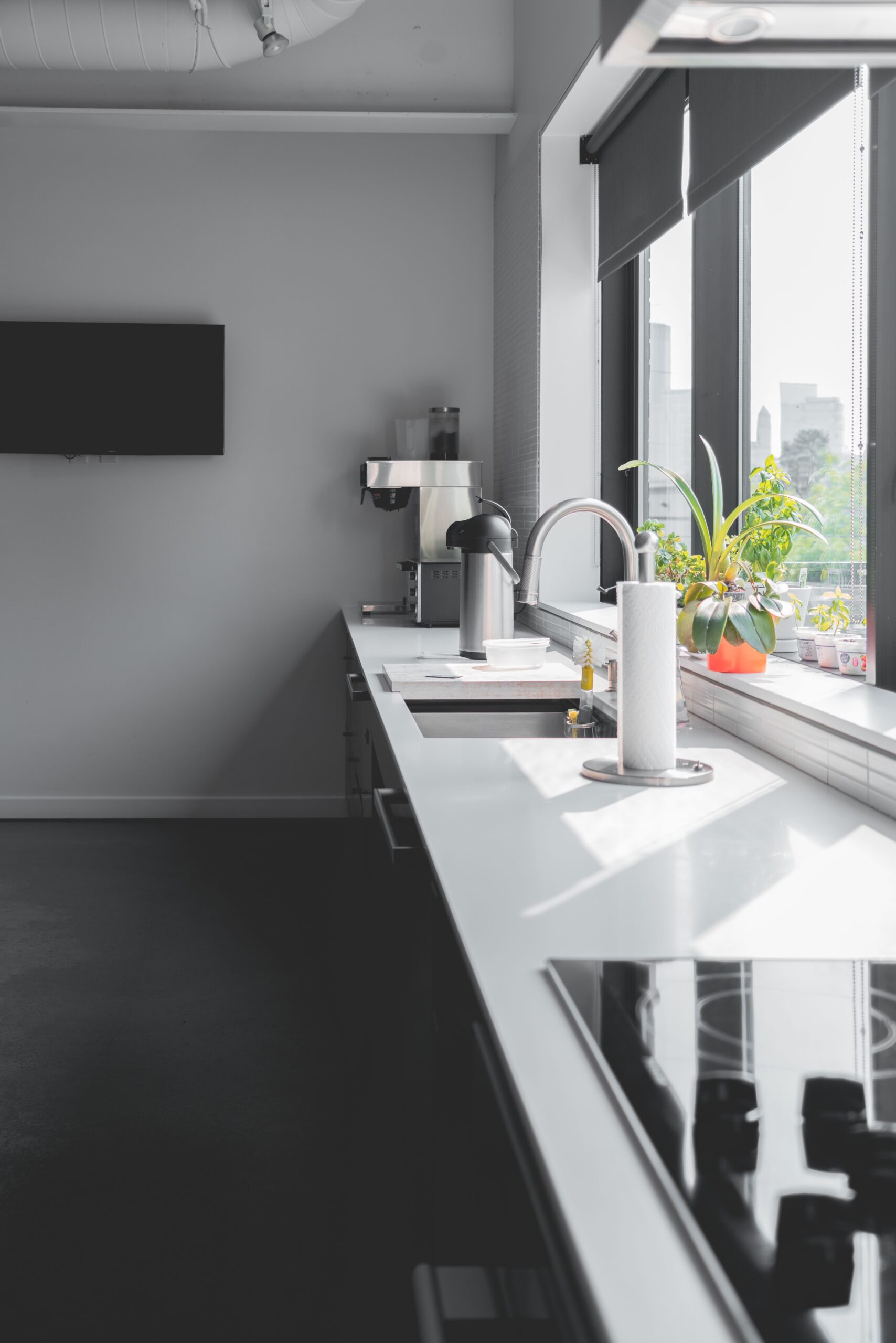
A minimalist kitchen is one in which every object, surface, and design element has its place. Minimalism in kitchen design is about keeping things streamlined and clean, retaining only the essential elements. People are increasingly seeking spaces that aren’t overwhelming because, as homes become smaller and lives busier, they want a more relaxing place to live. Even if you don’t realize it, a kitchen cluttered with mismatched appliances, cramped counters, and full cabinets can cause stress. By contrast, a minimalist kitchen has a certain visual quiet, organized before you open the first drawer.
The kitchen layout and elements of design.

A minimalist kitchen requires a solid foundation and a set of rules to guide the creation of that foundation before selecting a type of cabinetry or countertops.
Determine the purpose of your kitchen.
Great minimalist spaces begin with a clear purpose. What do you do in your kitchen? Do you cook for the whole family and enjoy baking, or do you cook every day for speed? Do you need a separate coffee station, or should it be used for meal prep?
Minimalism isn’t a one-size-fits-all approach; it’s about designing around your actual habits, not an idealized version of what you think you’re supposed to do when preparing meals. If you like to bake a lot, you’ll need different storage and counter space than someone who primarily reheats dinners. If you know what you want to do, you won’t remove what you’ll need or add what you won’t need.
Clean and organize countertops and cabinets
This is the most noticeable step toward making your kitchen minimalist. The countertops should be almost bare, with just a coffee maker or a knife block. The same holds for cabinets: organize like items together, eliminate duplicates, and discard broken, outdated, or unused items that are more than a year old. A good principle to follow is the “one in, one out” rule. For every new kitchen gadget you add, remove another. Getting rid of clutter isn’t something you do just once; it’s a practice that helps ensure the space doesn’t gradually pile up with unnecessary items.
Pick a Simple, Cohesive Color Palette:
Minimalist kitchens typically feature a limited color palette, with tones of white, neutral wood, and accent colors such as matte black or soft sage. This is not boring; it’s about achieving visual serenity. When colors and finishes flow together, the eye is not overloaded, which is one reason minimalist kitchens have a serene atmosphere.
One dominant neutral tone, such as white, cream, or light gray; one secondary material tone, such as natural wood or stone; and one accent material tone used sparingly, such as in hardware, a backsplash, or a single statement material tone. This is why it’s important to stick to a simple color scheme so the entire room appears purposeful rather than cluttered.
Form follows Function.
All additions to the kitchen should be considered first by asking: Will this improve the kitchen’s usability? While a beautiful pendant light is nice, it is also important to have adequate task lighting. It may be a beautiful design, but an open shelf will only be neat if it contains items you use, rather than those that are simply pretty but serve no purpose.
But that doesn’t mean minimalist kitchens lack personality; a single piece of art, an interesting light fixture, or a beautiful bowl of fruit will add warmth. The principle is that only a few items are carefully selected and found useful, rather than many items vying for a person’s attention.
Design an Efficient Kitchen Layout
Minimalism can be put to good use in layout. The old “kitchen work triangle” between the sink, stove, and refrigerator still works well: If you’re working in a kitchen, you don’t want to have to cross long distances between your three primary work areas.
Use zones around the triangle, a prep zone around the sink and cutting boards, a cooking zone around the stove, and a storage zone around the food and dish storage area. Keeping tools close to the job site minimizes wasted motion. Spices by the stove and cutting boards by the prep area help maintain an efficient, quiet environment, even during a hectic dinner rush.
Utilize natural light
Lights are integral to how the kitchen looks and feels, making it appear larger and more serene. Minimalist kitchens tend to be lighter and more open, with many windows to let in as much light as possible, and often use lighter colors to reflect rather than absorb light. If your kitchen is over a window or in close proximity to a prep area, be sure not to clog the window sill or the window itself with window treatments or clutter.
Choosing the Right Materials, Cabinets, and Appliances

Now that the principles have been established, the next stage is to apply them to the physical selection of cabinets, surfaces, and appliances that will make up the room. Less is more. In a minimalist design, these elements should feel purposeful: every element must be built to last a lifetime of work.
Flat-Panel Cabinets
The flat-panel cabinets, also known as slab or handleless cabinets, are a hallmark of minimalist kitchens. They feature uninterrupted surfaces without raised panels, molding, or ornate details. In many minimalist kitchens, handles are the next to vanish: many such kitchens use a push-to-open mechanism or integrated finger pulls. The style works especially well because it allows other features, such as a striking countertop or warm wood tone, to be seen, rather than the cabinets crowding them out.
Quality Countertops
In a minimalist kitchen, the materials you choose take center stage because there are few decorative elements, so they must be high quality. Quartz has become a popular option for its durability, low maintenance, and uniformity, making it ideal for busy homes. Natural stone offers unsurpassed depth and character but may require more maintenance. Wood countertops add warmth and texture to an otherwise sleek, cool material palette.
Regardless of the material you select, the idea is to find something that will work as a focal point, is not a show-stopper, is durable enough to use every day, and is pleasing enough that it doesn’t need embellishment.
Inbuilt appliances
Nothing undermines a pristine kitchen line more than a mismatch with the refrigerator or a large dishwasher that takes over the cabinet run. Appliances such as refrigerators, dishwashers and even microwaves will be built-in or integrated into the cabinetry, with panels that match the cabinet fronts.
This creates a sense of spatial continuity throughout the kitchen and emphasizes the underlying minimalist principle of visual quiet. While it will cost more than stand-alone appliances, it will offer many homeowners the added value of a unified design.
Open Shelving vs. Closed Cabinets
Today, open shelves are a popular addition to the minimalist kitchen, providing an open, uncluttered space that also allows easy access to everyday dishware. But if you’re interested in open shelving, you need to be disciplined about what you put on them, as they showcase everything. It requires good organization and beautiful dishes; otherwise, it’s not going to work.
Closed cabinetry, on the other hand, obscures the inevitable mess of everyday life, such as mismatched containers, bulk items in the pantry, or less attractive but essential tools. For many minimalist kitchens, there’s a balance: a short range of open shelving for items that are used frequently and look good on the shelves, and closed cabinetry for the rest. This combination is up to you and depends on how much you can tolerate seeing and how much time you’re willing to spend arranging.
Durable, Easy-to-Clean Materials
Minimalist kitchens do not require a lot of decoration, nor do they need to include a lot of materials that will fall into disrepair after a short time. Scratches, stains, and wear are much more evident in a pared-back space than in a more decorated and busy space. This means that durability and easy cleaning are not just desirable; they’re essential.
While beautiful, matte finishes are more prone to fingerprints and water spots than glossy ones. For the kitchen, choose scratch-resistant countertops, wipeable cabinet finishes, and stain-resistant floors, all of which help maintain a cool, clean appearance and make life easier.
Selecting a Smaller Number, But of Higher Quality Kitchen Essentials
Minimalism is not the doctrine of the absence of resources; it is the doctrine of the presence of resources. A minimalist kitchen may have just three good knives that will satisfy all the needs, instead of having ten mediocre knives. In the same way, when it comes to cookware, small appliances and tools, fewer items that are well-made, versatile and have a long lifespan are better options than a slew of specialized gadgets that are used only infrequently.
Styling a Minimalist Kitchen Without Losing Warmth.

The most common misconception about minimalist kitchen design is that it should be cold or sterile. In fact, a tastefully designed minimalist kitchen can be as welcoming and inviting as any other type of kitchen; it’s just that it creates the same warmth by selecting a few carefully planned items instead of filling the space with decoration.
Warm Lighting for a Welcoming Atmosphere.
Lighting can significantly shape the atmosphere of a space. A well-designed kitchen can feel clinical with overhead cool lighting, but warm, layered lighting instantly makes the room feel more inviting. Mix in different light sources: Use recessed lighting for the prep areas, warm-toned pendant lighting over an island, and under-cabinet lighting for a soft glow over the counter spaces at night. Dimmable fixtures are particularly beneficial because they can create a bright, efficient kitchen space when you’re cooking and a soft, cozy environment for dinner or a late-night snack.
Use of natural materials, such as wood and stone.
Natural materials are a great way to counteract the potential plainness of a minimalist kitchen. When a space is too homogeneous, a wood cutting board, open wood shelving, or a stone countertop with its visible veining can add texture and organic warmth. They age beautifully and get better with age, something which manufactured surfaces cannot compete with.
A limited colour palette with subtle contrast.
A minimalist kitchen is best rendered with a limited color palette, yet it’s important not to be “flat” with such a palette. A hint of contrast, such as warm white cabinetry with a deep walnut island or matte black fixtures with soft cream walls, provides depth and visual interest without detracting from the overall harmonious and subtle atmosphere. It’s contrast that matters, not one that is distracting.
Plants and herbs that can be grown indoors.
Nothing is more inviting in a kitchen than lush greenery. A few potted plants on a windowsill, or a single trailing plant on a freestanding shelf, will liven up a formally clean room with a touch of organic color. They also offer a practical advantage; fresh basil and rosemary within reach make cooking a bit more special and tie the decorative to the room’s use.
Minimal décor that complements the space.
Minimalist kitchen decorating does not mean no decorating at all; it’s simply a matter of making sure that every decorative element is deliberate. One painting, a lovely ceramic vase, or an interesting light fixture can serve as a subtle focal point for a room without dominating it. The secret is to focus on one or two significant items rather than adding many small, trifling pieces to the surfaces. If in any doubt: Less is more; 1 striking object works better than 5 smaller ones.
Beautiful organization of kitchen utensils, spices and pantry goods
The items used in a kitchen, even the mundane ones used every day, can add to the warmth and style of a kitchen. Glass or ceramic containers can be used to store pantry staples such as flour, rice, and pasta, making them look like design elements rather than necessities. Having spices in neat, tidy jars or a small collection of regularly used utensils in a crock near the stove infuses a homelike, intentional touch and demonstrates that a minimalist kitchen organization system can be both appealing and useful.
Keeping a Minimalist Kitchen Day-by-Day

You might have a minimalist kitchen, but maintaining it that way is another matter. Even the best-laid plans can fall apart if a few habits aren’t followed consistently.
Keep Countertops Clear
The simplest good habit to keep a kitchen from getting cluttered is to do a nightly cleanup and clear the countertops, or at least most of them, before you go to bed. Things tend to pile up during the day with mail, mixing bowls, and miscellaneous items, and a final sweep at the end of the day ensures that this doesn’t become a problem.
Organize Cabinets Regularly
As with countertops, cabinets should be inspected periodically; every few months is a good schedule. Set aside a few minutes to remove any items that are or were out of date, unused, or duplicated. This is a more consistent and manageable form of light “cleaning” than the once-a-year deep “declutter,” and helps cabinets function as intended.
Don’t keep appliances that are not used daily.
All kitchen utensils don’t have to be on the counter or in the key cabinet. Items used occasionally, such as a stand mixer, an air fryer, or a waffle iron, should be stored in a pantry, lower cabinets, or even a garage shelf, and used as needed. Use the most easily accessible space for the few items you need to use daily.
“One In, One Out” Rule
This simple rule is one of the best kitchen organization strategies a minimalist can use for long-term organization: “One in, One out.” When it comes to mixing bowls, a brand-new set means the odd ones out. New knife, old dull knife donated or thrown. This is a natural way to keep the volume of kitchen items under control without having to make major kitchen cleanouts once in a while.
Clean as You Cook
Rinsing bowls between tasks, cleaning counters while cooking something that’s bubbling, and putting away ingredients as soon as you’re done, etc., prevent things from getting messy in the kitchen when preparing meals. It also makes post-meal cleanup much less frightening, since the majority of the job is done before you eat.
Buy intentionally
Trending kitchen gadgets abound, and it’s easy to collect one-use-only items that then sit in your drawer for months on end. When considering purchasing a new kitchen tool or appliance, ask yourself whether it truly addresses a relevant and recurring issue and whether the same result can be achieved with an existing tool just as well. At the core of functional kitchen design is deliberate buying, where everything is included for a reason; a functional one, that is, not because it looked like a great idea to put in a store display.
Leave a Reply